
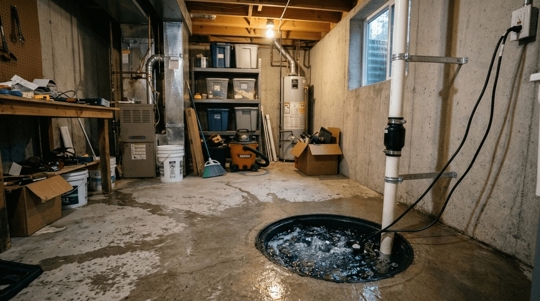
How do you know if your house needs a sump pump?
Your house may need a sump pump if water collects in a basement or crawl space, groundwater repeatedly reaches the foundation, or storms leave water gathering under or against the home. A sump pump is not necessary for every property, and surface drainage problems may be better addressed with grading or another drainage solution.
What conditions suggest a sump pump may be useful?
Start with the lowest areas of the home and the way water behaves during and after heavy rain. Sump pumps are designed to collect water in a basin and move it away from a vulnerable low area. They are most relevant when a basement or crawl space is exposed to recurring groundwater or water intrusion.
Standing water in a crawl space is one practical warning sign. Another is water that repeatedly collects against the foundation and finds its way into a lower interior area. A property with groundwater concerns may also need a planned way to collect and discharge that water before it causes repeated moisture problems.
The key word is recurring. One wet patch in a yard does not automatically mean the house needs a sump pump. The location of the water and the part of the structure at risk matter more than simply seeing water outdoors.
When might a sump pump not be the right solution?
A house without a basement or crawl space may have no low interior area where a conventional sump system would be useful. Many slab-on-grade homes fall into this category. If the problem is a soggy yard, runoff from a roof, or water collecting on the surface beside the house, the first issue may be how water is graded and drained across the property.
That distinction matters because a sump pump addresses water that needs to be collected from a low point and moved away. It does not automatically correct every exterior drainage problem. If water is being directed toward the foundation because of the way the ground slopes, improving drainage may be more appropriate than adding a pump.
What should you look at before deciding?
Review where the water starts, where it travels, and where it finally collects. After a storm, check the crawl space if your home has one and look for standing water or persistent dampness. Also observe whether water remains against the foundation instead of moving away from the structure.
A plumbing or drainage evaluation can help separate groundwater intrusion from a surface drainage issue. That distinction supports a better decision about whether a sump basin and pump are warranted or whether the property needs a different drainage correction.
Myth: Every home benefits from a sump pump
A sump pump is not a universal upgrade. Homes with basements, crawl spaces, groundwater exposure, or repeated low-area water collection may benefit, but a home without those conditions may have little reason to install one.
Sump pump decisions in Cedar Park, Texas
In Cedar Park, Texas, many homes are built on concrete slabs rather than over basements. That means the presence of rainwater around a property does not by itself establish a need for a sump pump. The useful question is whether water is repeatedly reaching a vulnerable low area of the structure.
For a Cedar Park, Texas property with a crawl space or unusual low area, standing water after storms deserves closer evaluation. For a slab home with water remaining in the yard, grading or another drainage approach may be the more relevant issue.
FAQ
Does every house need a sump pump?
No. Sump pumps are most useful where water repeatedly enters or collects in a basement, crawl space, or another vulnerable low area.
Can a sump pump fix a soggy yard?
Not necessarily. Surface water in a yard may point to grading or drainage conditions that should be addressed separately from an interior sump system.
Is standing water in a crawl space a sign I need one?
It can be. Repeated water collection in a crawl space is a reason to evaluate whether a sump basin and pump are appropriate.
What should be checked before installing a sump pump?
Identify where the water originates, how often it appears, and whether it is entering a basement, crawl space, or other low structural area.
How do you know if your house needs a sump pump?
Your house may need a sump pump if water collects in a basement or crawl space, the property has groundwater concerns, or water repeatedly pools against the foundation after storms. In Cedar Park, Texas, many slab-on-grade homes may not need one. Yard drainage problems can also require grading or drainage improvements instead of a pump.
Conclusion
A home is more likely to need a sump pump when water repeatedly collects in a basement, crawl space, or another low area affected by groundwater. If the issue is mainly surface water outside, drainage or grading may be the better place to start.