
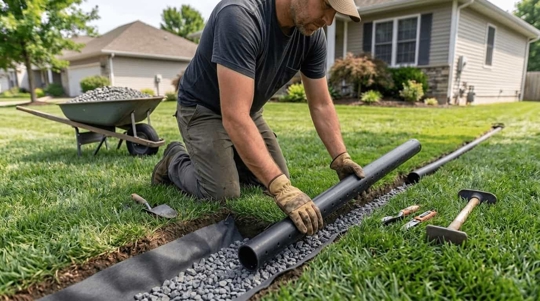
Can I install a French drain with the holes facing up?
You can install a French drain with the holes facing up, and it may still move some water, but it will generally be less effective than a pipe installed with the perforations facing downward. Downward-facing holes collect groundwater near the bottom of the trench, while proper slope, gravel, fabric, and discharge are also essential.
Why Should French Drain Holes Face Down?
A French drain works by collecting water that has entered the surrounding gravel and directing it through a perforated pipe toward a suitable discharge point. Although it may seem logical to place the holes on top so water can fall directly into the pipe, groundwater typically rises from the bottom of the trench rather than dropping into it from above.
When the perforations face downward, water can enter the pipe as soon as it reaches the bottom portion of the gravel bed. Once the water level rises to the holes, it enters the pipe and follows the pipe’s slope toward the outlet. This placement helps the system begin draining before the trench becomes heavily saturated.
If the holes face upward, water must rise high enough to reach the top of the pipe before it can enter. The gravel may still carry some water, and the pipe may eventually collect it, but the system will generally respond more slowly. More water can remain around the pipe and in the surrounding soil before drainage begins.
Perforated pipe designs vary, so installation instructions from the pipe manufacturer should also be considered. For common French drain applications, however, positioning the perforations downward or in the lower portion of the pipe is typically the more effective arrangement.
What Else Determines Whether a French Drain Works Properly?
Pipe orientation is important, but it is only one part of an effective French drain installation. A system with correctly positioned holes may still perform poorly if other components are missing or improperly installed.
Key installation factors include:
Consistent slope: The trench and pipe should direct water toward the intended outlet without low areas where water can collect.
Clean drainage gravel: Washed gravel creates open spaces that allow water to move toward the pipe. Soil-filled or compacted material can restrict that movement.
Appropriate filter fabric: Fabric helps separate the surrounding soil from the gravel, reducing the amount of sediment that can enter and clog the drainage layer.
A clear discharge point: Collected water needs somewhere appropriate to go. A blocked, undersized, or poorly positioned outlet can cause water to back up.
Correct trench placement: The drain must intercept the water’s path. A well-built drain installed away from the problem area may provide little improvement.
Accessible maintenance points: Depending on the system, cleanouts can make it easier to inspect or clear the pipe later.
Together, these details determine how efficiently the drain collects and carries water. Simply turning the holes downward cannot compensate for an inadequate slope or an obstructed outlet.
French Drain Installation Considerations in Leander, Texas
In Leander, Texas, yard drainage problems can become noticeable where runoff collects beside foundations, along low areas, or near hard surfaces. A French drain may help when the issue involves water moving through saturated soil, but the drain must be positioned to intercept that water and carry it to an appropriate location.
Downward-facing perforations are particularly useful because they allow groundwater to enter near the bottom of the trench. This helps reduce saturation at a lower level instead of requiring water to rise above the pipe first.
Site conditions should guide the installation. Soil characteristics, grading, utility locations, the distance to the discharge point, and the source of the excess water can all affect the design. Before installing a French drain in Leander, Texas, it is important to confirm that the planned outlet will not create a new drainage problem elsewhere.
Common Myth: Water Cannot Enter a Pipe With Holes Facing Down
A common misconception is that downward-facing holes will be blocked by the ground or prevent water from entering the pipe. In a properly constructed French drain, the pipe does not rest directly against compacted soil. It sits within clean gravel, which creates pathways for water to move beneath and around the pipe.
As water reaches the bottom of the trench, it rises into the downward-facing perforations. The pipe then provides a lower-resistance route toward the outlet. This is why facing the holes down does not stop drainage; it generally allows the system to begin collecting water sooner.
FAQ
Will a French drain fail completely if the holes face up?
Not necessarily. It may still collect water after the trench fills high enough, but it will usually begin draining later and may leave more water in the surrounding soil.
How much slope does a French drain need?
The pipe needs a consistent slope toward its outlet. The appropriate slope depends on the site, pipe, and discharge arrangement, so careful grading is more important than relying on a universal measurement.
Does a French drain pipe need gravel underneath it?
Yes. Clean drainage gravel beneath the pipe allows water to move freely toward the lower perforations and helps keep the pipe separated from soil that could restrict flow.
Can filter fabric prevent a French drain from clogging?
Filter fabric can reduce soil migration into the gravel, but it cannot prevent every blockage. Proper fabric placement, clean gravel, a suitable pipe, and an accessible outlet all support long-term performance.
Can I install a French drain with the holes facing up?
A French drain may still move some water with the pipe holes facing up, but it is generally less effective than installing the perforations downward. In Leander, Texas, downward-facing holes allow groundwater to enter near the bottom of the trench and flow toward the outlet. Proper slope, gravel, fabric, and a clear discharge point also matter.
Conclusion
A French drain can move some water with its holes facing up, but downward-facing perforations are generally more effective because they collect groundwater near the bottom of the trench. Proper slope, clean gravel, filter fabric, thoughtful placement, and a clear discharge point are equally important.
If you need help evaluating a drainage concern or planning a French drain, PlumbPros can assess the conditions and explain which plumbing or drainage approach fits the property. A professional evaluation can help identify the water source and support an installation designed around the site.